ABOUT
In the Middle Ages, located on the corner between today’s Muntplein (Place de la Monnaie) and Schildknaapstraat (Rue de l’Écuyer), was a small but important chapel – ‘Sint-Eligiuskapel’ – dedicated to the saint of all tradesmen. In those times, this chapel was not just a place of worship but a self-funding charitable guild to help the ill and the weak of Brussels’ artisan class.
Origin
Who was Saint Eligius?
Before we dive into the history of the Sint-Eligiuskapel in Brussels, let’s first explore who the saint was and why he was so venerated in the Low Countries.
Born in today’s western France not far from Limoges, Eligius (588–660) was a Gallo-Roman Christian and a talented goldsmith. During this time, Gaul was part of the Germanic Frankish Kingdom (481–843).
Through his craft, Eligius became employed in the Frankish court and favoured by King Clotaire II and then his son King Dagobert I.
In 642, Eligius became the Bishop of Noyon–Tournai, a position he held until his death in 660 at the ripe age of seventy-two. There, he was responsible for the conversation of a large part of the population, who for the most part had remained pagan. He travelled to the most remote and savage northern part of Neustria to convert Gallic tribes like the Nervii, the Morini, the Menapii, as well as the Germanic tribes like the Suebi and the Franci. This is the reason why Saint Eligius was particularly worshipped in Northern France and the Low Countries. His name in Lower Frankish (today’s Dutch) lingers on as ‘Sint-Elooi‘, ‘Sint-Eloy‘, ‘Sint-Looi‘, ‘Sint-Loo‘, ‘Sint-Loy‘, and in northern Romance languages such as Walloon and Picard as ‘Sint Elwè‘, ‘Sint Éloy/Éloi‘.
As Eligius was a goldsmith and a talented artist, he became the patron of all tradesmen and artists, including blacksmiths, saddlers, painters, and bakers.
1476: The Construction of the Sint-Eligiuskapel in Brussels
It is not known when the Sint-Eligiuskapel as an institution was founded. Like the Sint-Laurentiuskapel, it was not simply a chapel, but a foundation that served a specific group of people for a specific goal. To start, the worship of Eligius meant that the chapel served all tradesmen and artists.
What the records show, was that in 1447, a goldsmith named Niklaas van der Bulet gave a house located on the Lange Ridderstraat (today’s Schildknaapstraat) beside the property of Willem de Hornes, Lord of Duffel and that of the heirs of the Hans, as a residence for the foundation’s receiver. Here, the Sint-Eligiuskapel was built in 1476, against the large domain of the powerful Dominicans in the Predikherenklooster.
What's so special about this place?
The Social Network for Artisans
The Sint-Eligiuskapel was established as a brotherhood under the patronage of the saint. According to an act of 1562, the foundation was formed very early on by craftsmen, and it has always retained its leadership, without the magistrate ever interfering.
Each member paid a weekly subscription and received assistance in the event of illness or accident.
Thirteen people, three masters and ten directors, all chosen by the represented trades, were responsible for distributing alms every Sunday and for travelling through the parishes on the four major feast days of the year, as well as on Saint Martin’s Day, to bring a double ration to the sick. On Saint Martin’s Day, each poor person in the brotherhood also received a jug of beer, a loaf of bread, and a small portion of wine. The brotherhood inherited the bed of any sick person who died, thus exercising, in a way, the right of mortmain over its members.
With such a large membership, one would have thought the Sint-Eligiuskapel have exercised an enormous amount of political power. Yet, artisans’ guilds do not partake in the higher level of administration of the city, which was run by the aldermen who were from powerful patrician families.
By the 18th century, Sint-Eligiuskapel seemed to have grown in resources. It enlarged its goals by providing relief indiscriminately to all the poor and the sick. In 1776, its revenues that year amounted to 13,215 florins.
How did it look like?
The original 15th century chapel was destroyed by the French Bombardment of Brussels in 1695. It was rebuilt thereafter exactly as how it looked like before.
Its altar was designed by Cornelis van Nerven (1660- 1715), who also was the principal architect for the reconstruction of the Grote Markt. The altar featured a painting by Jan van Orley (1665-1735) featuring “Saint Eligius distributing alms” (1701-1703).
Somehow this painting landed up in the Saint John’s Hospital (Sint-Janshospitaal) and is now located in the Holy Trinity Church (Kerk van de Heilige Drievuldigheid) and named “Saint Eligius healing the sick“.
Current situation
Muntpunt: The State of the Art Library and Meeting Point
After the French occupation at the end of the 18th century, Sint-Eligiuskapel disappeared both as a place of worship and as a charitable institution. In 1798, in its place came a Salle des Nouveautés (Hall of Novelties) which housed a curious combination of a woodwork shop and a dance hall. The worship part of the chapel must have survived because the Methodists were there briefly in 1804 and then a synagogue in 1817. That didn’t work. So in 1818, a Hôtel du Rabot was set up. Again, that only lasted until 1820 when the whole block was acquired by the cuty and redeveloped into a shopping mall called ‘Passage de la Monnaie‘.
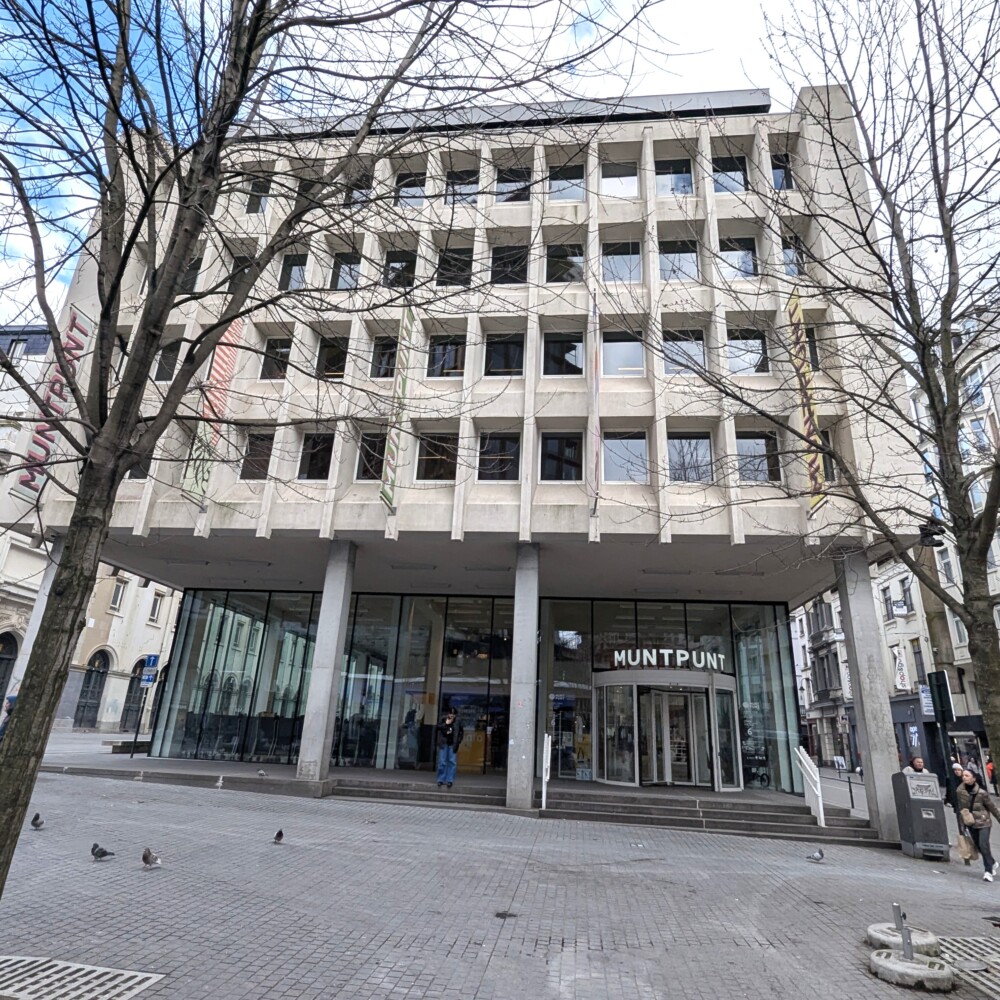
By the 21st century, the whole block along the Schildknaapstraat which contained a 1970s office building, a 19th century property and a house, was torn down to make way for a new development.
Today, it is a state-of-the-art Dutch language library known as ‘Muntpunt‘. The largest salon in Brussels, its rooms and corners house 8900 m2 of books, information and meeting spaces.
Sources:
Vannieuwenhuyze, B. (2011) “Brussel, de Ontwikkeling van een middeleeuwse stedelijke ruimte.” Amsterdam: Amsterdam University Press.
Henne, A. Wauters, A. (1845) “Histoire de la ville de Bruxelles. Volume I-III” Brussels: Librairie Encyclopédique de Périchon.
Rombaut, J-A. (1777) “Bruxelles illustrée, ou description chronologique et historique de cette ville.” Brussels: Chez Pauwels.
https://nl.wikipedia.org/wiki/Eligius
https://muntpunt.be/
https://b-architecten.be/projects/muntpunt
- Unknown. (1770) “Former Dominican monastery of Brussels in 1770” Wikipedia Commons (image)
- van Orley, Jan. (1701-1703) “Saint Eligius distributing alms” Kerk van de Heilige Drievuldigheid (image)