Oud Brussel: #24 Sint-Jacobsgasthuis
Name on the map:
S Iacopsgasthz
Original name in Dutch:
Sint-Jacobsgasthuis
Other names:
Sint-Jacob aan der Overmolen, Sint-Jacob van de Goede Bijstand
19th century name in French:
Hôpital Saint-Jacques d’Overmolen
Current name:
Onze-Lieve-Vrouw van Goede Bijstand, Église Notre-Dame de Bon Secours


ABOUT
In 1328, a ‘gasthuis’ was built beside Brussels’ old city gate of Overmolenpoort, dedicated to Saint James. The Sint-Jacobsgasthuis (Saint James Guesthouse/Hospital) was located along the busy Kolenmarkt (Marché au Charbon), where the Onze-Lieve-Vrouw van Goede Bijstandkerk (Église Notre-Dame de Bon Secours) now stands. The area was historically known as the “Hoek” or “Ververshoek” (Dyers’ Corner) just inside the first city wall, between the coal market and the winding Zenne river. The Overmolenpoort was one of Brussels’ first city gates dating from the 13th century and it led directly onto the bridge to the ‘Klein Eiland’ (Small Island) in the river.
Origin
An Overview of Brussels’ Hospitals in the Middle Ages
In the 12th century, when Brussels was first taking the form of a city, medical care for the population was like the rest of western and northern Europe a task administered by the church. The first hospital – for the poor – was established in 1127 by the chapter of the Collegiale kerk van Sint-Michiel en Sint-Goedele, dedicated to the Virgin Mary and the Twelve Apostles. The second one was set up in 1129, at the Sint-Niklaaskerk. The third was requested by Duke Godfried III of Brabant in 1162 to the Order of the Hospitaliers of Saint John of Jerusalem to set up a hospital at the Saint James Church by the ducal palace, the Sint-Jacob-op-Koudenberg.
By the 14th century however, the nature of medical care changed with the subtle appearance of the merchant class. At this time, four hospitals with entirely different ways of functioning and organisation were formed: the Sint-Jacobsgasthuis (Saint James Guesthouse) closed to the Overmolenpoort (circa 1324), the Sint-Corneliusgasthuis (Saint Cornelius Guesthouse) on the Steenwech (circa 1350), the Sint-Juliaangasthuis – Sint-Gillijnsgasthuis in local tongue (Saint Julian Guesthouse) (1356), and the Sint-Laurentiusgasthuis (Saint Laurence Guesthouse) (circa 1360).
To clarify, the term in Dutch “Gasthuis” and in English “Guesthouse” are the direct equivalents of the Latin term “hospitia” from which the Norman French words “hospital” and “hotel” derived. It is not today’s idea of a holiday rental. Rather, these were places that offered food and care, especially medical care, for the poor, for the injured, for travellers (often pilgrims who were travelling somewhere to pray for recovery from an illness).
According to Thibault Jacobs, in his work “Des hôpitaux de métiers à Bruxelles ? Nouvelles perspectives sur la charité et la bienfaisance en milieu urbain à la fin du Moyen Âge“, the misconception inherited about medical care in the Middle Ages in Brussels, and certainly in the whole of Brabant, that it was administered only to the poor and the pilgrims is very much misguided.
This traditional misconception presumes that prior to the French Revolution, medieval Europe existed only in three estates: the clergy, the nobility, and the commoners. With increased mobility and trade, even before the commoners rose up in France, there were signs of a growing merchant class that was organising itself. We can see that with the predecessor of social security offered by the Sint-Lookapel for the profession of craftsmen.
With the four hospitals in Brussels, we can see that they are in fact proof of a merchant class taking care of itself.
The Founding of the Sint-Jacobsgasthuis: For Pilgriums or Dyers?
The origins of a dedicated St. James foundation in Brussels are deep. An act from 1185 mentions a “Henricus presbyter de hospitali Sancti Jacobi” (Henry, priest of the hospital of St. James), suggesting a religious hospice existed near a St. James church at that very early date. Most likely, this referred to the Sint-Jacob-op-de-Koudenbergkerk (Church of St. James on Coudenberg) which existed around 1100 as a chapel for the defense castle on the hill.
The Sint-Jacobsgasthuis (Hôpital Saint-Jacques d’Overmolen) as we know it in the later medieval period was firmly established in the early 14th century, with its first clear mention in an act from 1324. Contrary to the long-held belief that it was primarily a hostel for pilgrims, recent scholarship (by both Bram Vannieuwenhuyze and Thibault Jacobs) suggests its 14th-century revival and role were more complex and deeply rooted in Brussels’ urban society.
The hospital was established in a house acquired in 1327 near the Overmolenpoort. A key figure in its early history appears to have been Gossuin Ghorijs, a burgher of Brussels, who acquired properties that later formed the hospital’s patrimony. While a confraternity of Saint James was associated with the hospital from its early days (mentioned in a 1328 charter from Duke Jan III), it was likely not the founder but rather grew around the existing institution.
The Sint-Jacobsgasthuis was situated in a quarter dominated by the textile industry — dyers, fullers, and cloth dressers. Analysis of the confraternity’s membership lists (1357-1419) shows a strong predominance of these very trades (over 21% of known professions), alongside butchers. This indicates the hospital was less a specialized pilgrims’ hostel and more a “craft hospital” (hôpital de métier). It served as a charitable institution for the poor and indigent, but also as a social, economic, and identity-forming hub for the local community of artisans, especially those from the textile trades. The confraternity held banquets and stored its ceremonial linens and glassware there, making the “gasthuis” a central community pillar.
The dedication to Saint James the Greater naturally suggests a link to the famous pilgrimage to Santiago de Compostella. The hospital was certainly situated along the “Via Brabantica,” a northern branch of the pilgrimage route that ran from Bergen-op-Zoom through Antwerp and Brussels towards the south. Early modern tradition held that it offered shelter to weary pilgrims, and on the feast day of St. James, a grand procession featured statues of the saint and his “valet” (called St. George by the people) on horseback.
However, the earliest 14th-century sources (1324-1343) consistently describe the Sint-Jacobsgasthuis as an “hospitale pauperum” (hospital of the poor) intended for “Christi pauperes” (Christ’s poor) and the infirm. Donations were made for buying linens “on which to lay and shelter the poor.” There is no specific early mention of “peregrini” (pilgrims). The dedication to Saint James, the patron saint of travellers, likely indicates a general concern for the poor and wayfarers, rather than an exclusive focus on Compostela pilgrims. The hospital’s primary identity was shaped more by its urban craft milieu than by the pilgrimage route.
What's so special about this place?
1664-1694: The Transformation of Sint-Jacobsgasthuis into the Onze-Lieve-Vrouw van Goede Bijstandkerk
The medieval hospital and its chapel underwent a profound transformation in the 17th century, shifting its focus from Saint James to the Virgin Mary in a remarkable story of popular devotion.
In 1625, Jacob Meeus, a master shoemaker and provost of the St. James confraternity, found a small, 14th-century wooden statue of the Virgin among old clothes and rags. He placed it on a pillar in the chapel. Soon after, he claimed his servant, Nicolas de Lanoy, was healed through the statue’s intercession. In the fervent climate of the Catholic Reformation, this was enough to spark a widespread cult. The statue was quickly attributed with miraculous power.
An eremite named Simon Petit-Jean, who spoke French, Spanish, and Italian, was appointed sacristan with the specific duty of recounting these miracles to the faithful. The statue was first called “Onze-Lieve-Vrouw in den Wyngaert ranck” (Our Lady in the Vine Garland) due to its decorations, and later “Onze-Lieve-Vrouw van Goede Bijstand” (Our Lady of Good Support/Notre-Dame de Bon Secours), after a similarly venerated statue in Spain. Its discovery in a chapel dedicated to the patron saint of Spain was seen as a happy omen for the Habsburg monarchy of Philip IV.
The cult exploded. From Lent to August 1625, 2,000 masses were celebrated before the statue, and offerings reached 2,900 florins. Archduchess Isabella enrolled as the first member of the newly founded Marian brotherhood in 1628.
The old chapel was soon overwhelmed. In 1664, the city magistrate authorised a complete rebuild. The first stone of the new church was laid in 1664, but construction lasted thirty years under successive architects: Jan Cortvrindt (d. 1681), Pieter-Paul Merckx (d. 1685), and finally Willem de Bruyn, who completed it in 1694. Barely a year later, the church was severely damaged during the devastating 1695 bombardment of Brussels by French troops under Marshal de Villeroy. The roofs, dome, plasterwork, and furnishings were ruined, necessitating immediate and extensive restoration from 1696 to 1699.
How did it look like?
Old and Dilapidated
The sources provide few details on the physical appearance of the medieval hospital complex of the Sint-Jacobsgasthuis. It consisted of housing for the poor and a chapel. The old chapel, dedicated to St. James, was divided into a nave with two exits (one to the street, one to the hospital) and a choir separated by a wall with two doors. The choir contained two altars separated by a pillar: the altar of St. James (west) and the altar of St. Ontkommer (east). By the mid-17th century, the buildings were described as very dilapidated and the chapel too small, leading to their complete reconstruction.
An Italian Baroque Wonder in Brussels
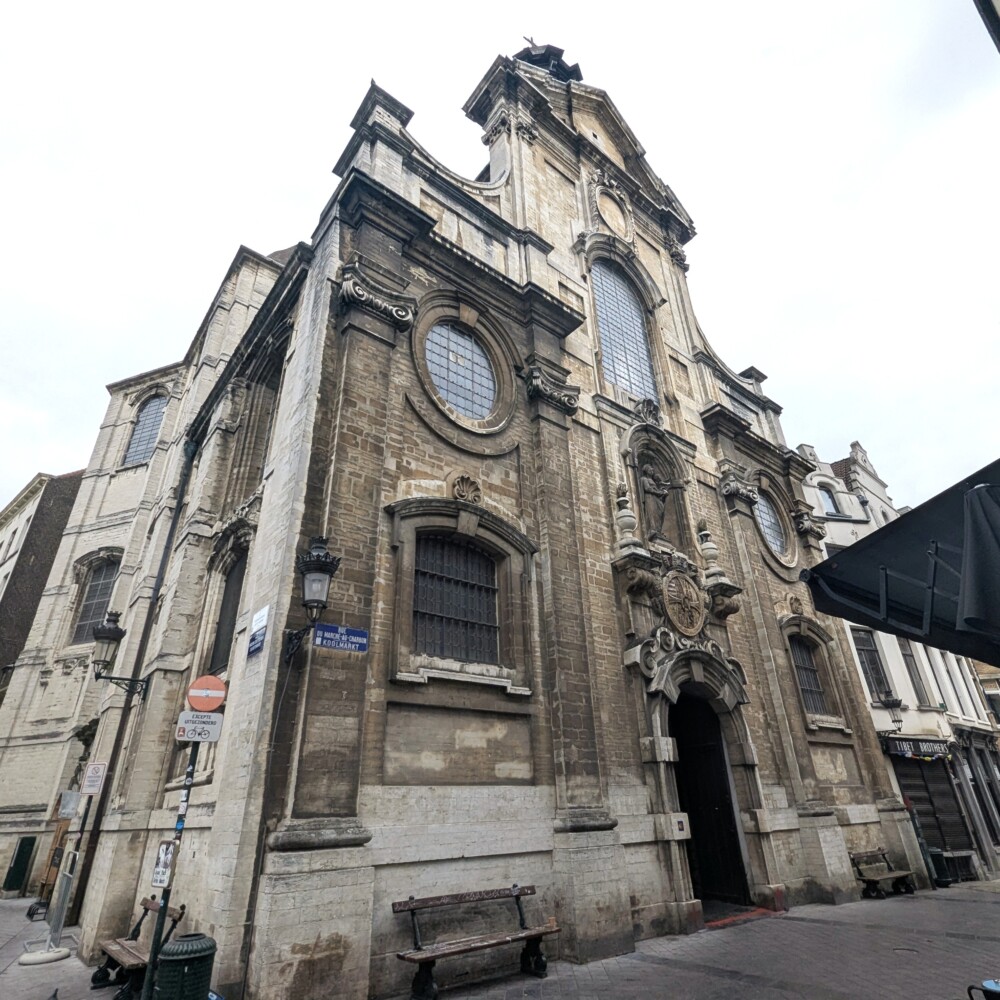
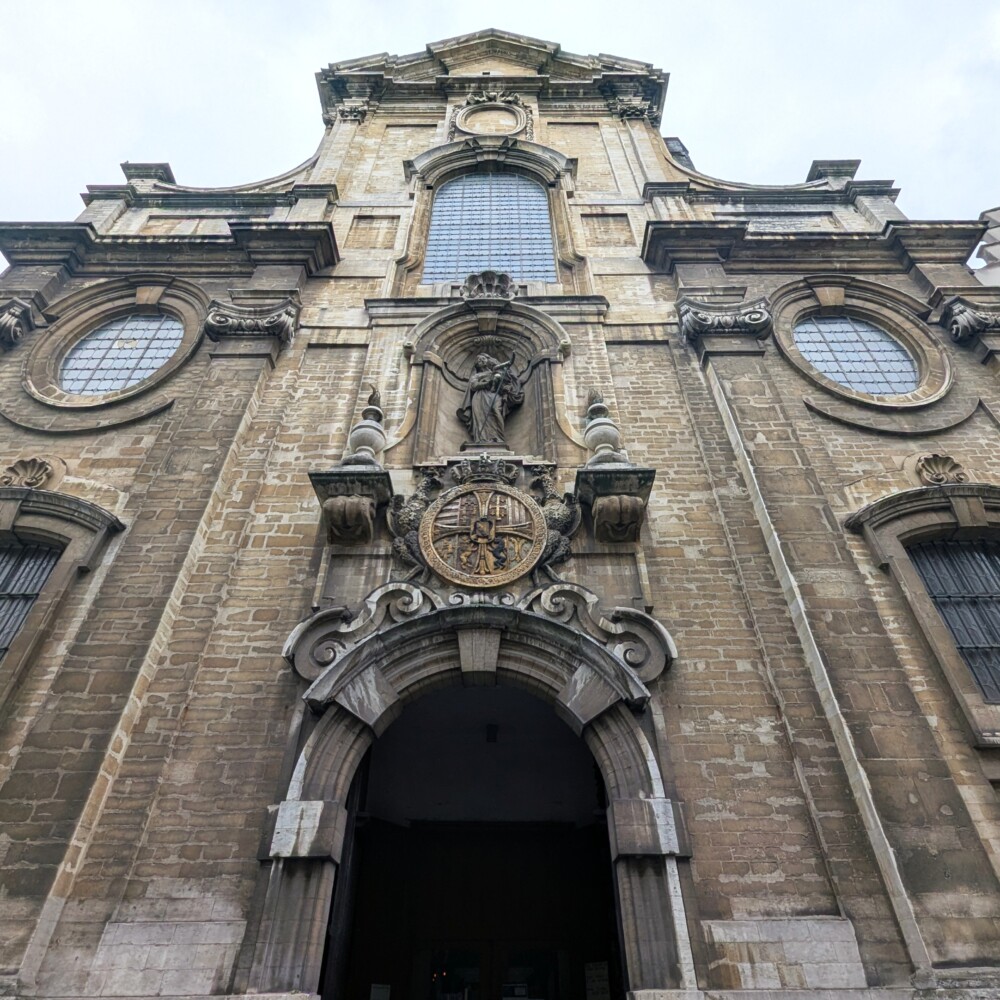
The Onze-Lieve-Vrouw van Goede Bijstandkerk on the other hand, was and is a masterful and original example of Baroque architecture in Brussels, successfully blending Italian Baroque principles with traditional local schemes.
Exterior: The elegant, well-proportioned facade on the Kolenmarkt (Marché au Charbon) features three bays framed by towering Ionic pilasters on high socles. The central bay is accentuated by a grand arched portal in a moulded frame, topped by a beautiful 17th-century wooden door lintel (‘makelaar‘) carved with hat and shell motifs referencing St. James, likely by J.B. Tons. Above this sits the sculpted coat of arms of Karel van Lotharingen (Charles of Lorraine, 1712-1780), the Governor of the Habsburg Netherlands (1741-1744, 1749-1780) — a reconstruction after the original was destroyed by French occupiers in 1793. Higher still, in a shell-topped niche flanked by stone vases, stands the statue of the Virgin and Child by Godefroid van den Kerckhove (1910-1911). Before this statue was placed here, it was another image: “Virgin and Child standing on a Snake“, carved by star sculptor Servaes Cardon (1608-1649) around 1625-1649. Originally painted in white, this priceless sculpture survived the French bombardment and is now exhibited in the Brussels museum Broodhuis (see below). The small bell tower, designed by Hendrik Partoes in 1850, replaced an earlier glass lantern removed in 1727.
Interior: The space is breathtakingly bright, open, and vertical, thanks to the ingenious design. A shortened three-aisled nave of only two bays opens into a monumental hexagonal central space beneath a high, six-sided dome. This creates a stunning spatial effect. Innovative galleries run above the side aisles. The decoration is sober but rich: plastered walls and vaults with stucco work, natural stone pilasters, and gilded capitals.
Key artistic treasures include:
- The 14th-century polychrome wooden statue of Onze-Lieve-Vrouw van Goede Bijstand, the miraculous figure at the heart of the devotion.
- The magnificent high altar (1705) in marble and painted wood, designed by Jan-Pieter van Baurscheit de Oudere. Above it, a stained-glass window bears the arms of King Charles III (later Habsburg Emperor Charles VI), donated by the Finance Council in 1707.
- The exquisite white marble holy water fonts from the 18th century, delicately adorned with cherubs’ heads, crafted by the famous Flemish sculptor Gabriël Grupello (1644–1730).
- Side altars dedicated to St. James and St. Joseph, containing wooden statues of these saints by Jan Baptist van der Haeghen (1724). The statue of St. James is depicted as a pilgrim, complete with cloak, broad-brimmed hat, staff, scallop shell, and gourd.
- Medallions on either side of the high altar, attributed to Gilles-Lambert Godecharle, depicting Mary’s parents, Joachim and Anna.
- Beautiful confessionals in Louis XIV style, intricately carved with images of a harp-playing King David, Mary Magdalene, and Mary of Egypt.
In one of the chapels in the church, was an old silver(?) chain containing the guilds that have dedicated to the chapel (see below). Made between 1762 and 1829, they contain the following inscriptions:
- “Nieuwe cappellen O.L van Bystant B V O I 1762”
- “Joan Schurmans Eerst conik stapel der gulde van cappelle 1764”
- “P L U H mont prins van nieuw cappelle van de gulde van O.L.V van Bijstant anno 1805”
- “Ioannes nijs den eersten prins van nuwe capelle van de gulde van O.L.V van Beijstant anno 1767”
- “P. Claes Prins van nieuw capelle van de gulde van O.L.V. van Bijstant anno 1829”
- “10 annes nijs den eersten : prins : van-nuwe cappelle : Van de gulde van : ons L.V.van Beijstant anno 1780”
This medallion chain shows that right up to the early 19th century, the language was the common inhabitants of Brussels was Dutch.
Current situation
The Golden Shells and a Living Parish
Today, the Onze-Lieve-Vrouw van Goede Bijstand is a vibrant Dutch-speaking parish, a role it has held since 1968 to serve the needs of Dutch-speaking Catholics in Brussels. Its historical link to the pilgrimage to Santiago de Compostela remains visibly present in the urban landscape.
Walkers in Brussels may notice golden scallop shells embedded in the sidewalks. These are not mere decoration but official European waymarkers for the ‘Compostela pilgrimage route’. About fifty of them trace a path through the city, connecting the Onze-Lieve-Vrouw-van-Goede-Bijstandkerk in the ‘Sint-Jacobswijk‘ (the neighbourhood named after the site of the old Sint-Jacobsgasthuis) with the Sint-Jacob-op-Koudenbergkerk near the Royal Palace. From here, they show two routes leading out of Brussels towards Paris: one via the Sint-Pieter-en-Sint-Guidokerk in Anderlecht, the other through the Marolles to the Hallepoort. In Hallepoortpark, a 1999 menhir-shaped sculpture called “Pelgrim” by Spanish artist Manolo Paz pays homage to the anonymous Compostela pilgrim.
Left of the church in the street called Olivetenhof (Rue du Jardin des Olives), there is a water fountain on the street itself that is filled with these golden shell icons.
These golden shells, a modern intervention by the City of Brussels, create a tangible, shimmering link between the city’s medieval past as a hub for travellers and its living present, forever tying the Baroque church of Our Lady to the ancient road of St. James.
Sources:
Vannieuwenhuyze, B. (2011) “Brussel, de Ontwikkeling van een middeleeuwse stedelijke ruimte.” Amsterdam: Amsterdam University Press.
Henne, A. Wauters, A. (1845) “Histoire de la ville de Bruxelles. Volume I-III” Brussels: Librairie Encyclopédique de Périchon.
Rombaut, J-A. (1777) “Bruxelles illustrée, ou description chronologique et historique de cette ville.” Brussels: Chez Pauwels.
Jacobs, T. (2013) “Des hôpitaux de métiers à Bruxelles ? Nouvelles perspectives sur la charité et la bienfaisance en milieu urbain à la fin du Moyen Âge” Brussels: Revue belge de philologie et d’histoire/Université Libre de Bruxelles.
https://nl.wikipedia.org/wiki/Onze-Lieve-Vrouw_van_Goede_Bijstandkerk
https://historiek.net/olv-goede-bijstand-kerk-brussel/35781/#.VwkryTH4ZIZ
https://www.parcum.be/nl/herbestemming-kerken/onze-lieve-vrouw-van-goede-bijstand
https://focusonbelgium.be/nl/wist%20u%20dat/wist-u-dat-de-gouden-schelpen-op-de-brusselse-voetpaden-naar-compostela-leiden
https://monument.heritage.brussels/nl/buildings/31346
https://www.bruxellesmabelle.net/nl/lieux/eglise-notre-dame-de-bon-secours/
-
-
- Van Deventer, J. (1550-1565) “Atlas of the city of the Low Countries : 73 minutes between 1550-1565 on orders of Emperors Charles V and Philip II” KBR (image)
- Braun, G, Hogenberg, F. (1572-1617) “Civitates orbis terrarum” Universiteitsbibliotheek Utrecht (image)
- de Tailly, M., van der Horst, N., Santvoort, A. D. (1640) “Bruxella nobilissima Brabantiae civitas anno 1640” KBR (image)
- Laboureur, J., Van der Baren, J., Harrewijn, J. (1695) “Bruxella Nobilissima Brabanti Civitasae” Bibliothèque Nationale de la France (image)
- Cardon, Servaes. (1625-1649) “Maria with Child and Snake; Onze-Lieve-Vrouw van Goede Bijstand” Broodhuis, Brussels (image)
- Van Baurscheit, Jan Pieter I. (1705) “High Altar Design for the Onze-Lieve-Vrouw-van-Bijstandskerk” Broodhuis, Brussels (image)
- Unknown. (1762-1829) “Gildenketting voor een kapel van de Onze Lieve Vrouw van Bijstandskerk” Broodhuis, Brussels (image)
- Van Moer, Jean-Baptiste. (1870) “De Zenne bij de Goede Bijstandmolen” Stadhuis, Brussels (image)
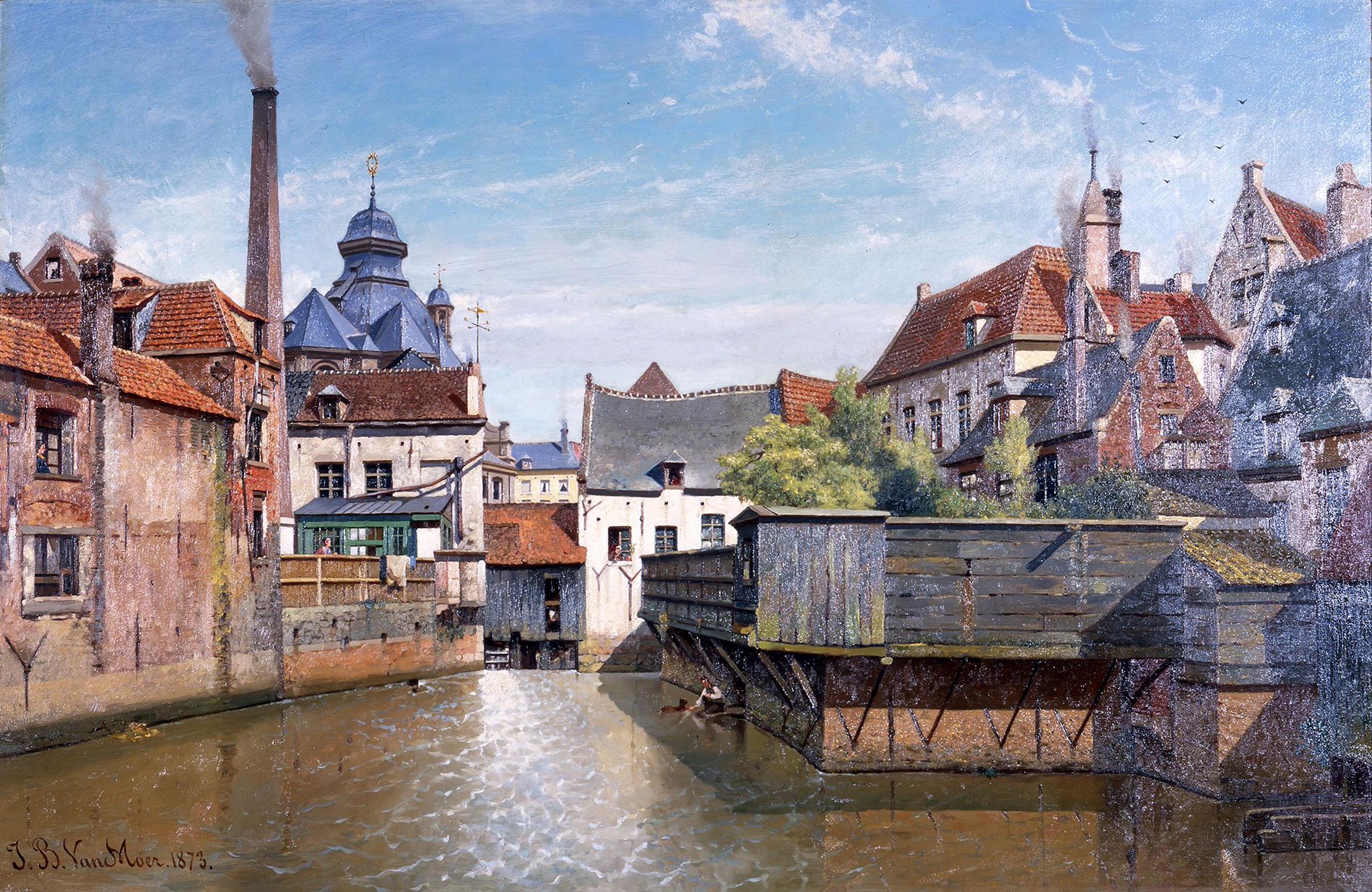
- Van Moer, Jean-Baptiste. (1873) “De Ezelmolen, nabij de Onze-Lieve-Vrouw van Goede Bijstandkerk” Stadhuis, Brussels (image)
- Baes, Jean-Baptiste. (1888) “L’église Notre-Dame du Bon Secours” Maison du Roi, Brussels (image)
- Carabain, Jacques. (1897) “L’église Notre-Dame de Bon-Secours depuis la rue des Grands Carmes” Maison du Roi, Brussels (image)
- Forestier, Amédée. (1908) “Entrance to the Old Church of Bon Secour” (image)
- Wellens, Charles. (1907-1959) “Rue du Marché au Charbon et l’église Notre-Dame du Bon Secours” Maison du Roi, Brussels (image)
- Unknown. (1900?) “Eglise N.D. de bon secours” (image)
-
HOW IT LOOKS LIKE TODAY
Click on the zoom icon to view the full size.