ABOUT
On the spot of today’s Sint-Gorikshallen (Halles Saint-Géry) once stood the Sint-Gorikskerk – Church of Saint Gaugericus, from the early Middle Ages right until the end of the 18th century. Located on the largest island in the River Zenne, the Sint-Gorikskerk was closely associated with the founding myth of Brussels.
Origin
Who was Saint Gaugericus?
Before we deep dive into the history of the Sint-Gorikskerk, we need to understand who Saint Gaugericus was and why he was so important to the development of Brussels from a backwater village into the capital of the Catholic Habsburg Netherlands.
Known as ‘Gorik’ in Dutch and ‘Djèri‘ in Walloon languages, Gaugericus was the Bishop of Cambrai-Arras from 585 until this death in 619.
To provide you with the historical context, the Western Roman Empire fell towards the end of the 4th century. By this time, Frankish tribes had already established themselves in the northwest of the empire in the province of Gallia Belgica. Their leader, King Clovis I, ruler of the Salian Franks, united all Frankish conquered territories in 509 by kicking out his relatives. This covers much of today’s France, Belgium, the Netherlands and Luxembourg. As a smart political move, he was baptised a Christian between 498–506, which laid the foundation of the Catholic Church in the whole of Western Europe.
Fast forward to the reign of Childebert II (c. 570 – 596) of Austrasia, great-grandson of Clovis. To claim legitimacy over such a vast domain that used to be part of the mighty Roman Empire, it was vital that the Franks, who were newly arrived Germanic pagans, convert to the Roman state religion of Christianity. This legitimacy was only officially sealed when Charlemagne was crowned Emperor of the Holy Roman Empire in 800 by Pope Leo III in Rome.
When Childebert II appointed Gaugericus as Bishop of Cambrai, then known as ‘Camaracum‘ in Latin and ‘Kamerijk‘ in Dutch (the modern direct descendant of Frankish), the cleric’s role was to convert all the pagans in the Frankish kingdom of Austrasia. Gaugericus then went about preaching and converting by travelling to far-flung rural villages, perhaps even to a backwater pagan Frankish village by the River Zenne called Brussels, owned by the Lords of Aa. He also founded abbeys and churches, including one monastery in his own city of Cambrai dedicated to Saint Medard.
The Sint-Gorikskerk and the Founding Myth of Brussels
According to legend, in the year 580 (which was strangely five years before his appointment as Bishop of Cambrai), Saint Gaugericus arrived in the village of Brussels as part of his mission to convert pagans.
Whilst he was there, he managed to chase a dragon from its lair and freed the people of Brussels from its tyranny. To commemorate his own dragon-slaying efforts, he built another chapel further up the hill, dedicated to Saint Michael the Dragon Slayer. This chapel later became the Saint Michael’s Church – Collegiale kerk van Sint-Michiel en Sint-Goedele.
And then on the largest island on the River Zenne, called ‘Het Groot Eiland‘ literally ‘The Great Island’, he built a chapel. This was the myth of how the Sint-Gorikskerk was founded.
But not everyone agreed that the chapel was founded by Gaugericus himself back in the 6th century. Another account said the chapel was built by Pepin of Landen (c.580–640), a highly respected Mayor of the palace of Austrasia and great-great-grandfather of Emperor Charlemagne. Other accounts claimed that the chapel was built and dedicated to Saint Gaugericus only in the year 948 on the ruins of an older chapel to Saint Vindicianus, also Bishop of Cambrai (c. 632 – 712).
To the early chroniclers, it seems that the establishment of the two chapels – one to Saint Gaugericus and another to Saint Michael – was directly responsible for the founding of Brussels.
The Relics of Saint Gudula Cometh
Saint Gudula of Brabant (c.646–712) was the youngest daughter of a Duke Witger of Lotharingia and Saint Amalberga of Maubeuge. Not much was known about her life except that she was kind and pious. The only record came from an 11th-century biography written by Onulfus of the Hautmont Abbey between 1048 and 1051. After her death, she was interred in a church where she lived, in today’s Moorsel.
What is significant is that she became identified with the ‘Brabantgouw’ – the Frankish version of the Roman territorial division called ‘pagus‘. ‘Gouw’ or ‘Pagus’ is often translated as ‘shire’ in English. The Brabantgouw is the predecessor of the later Duchy of Brabant. In the early Middle Ages, it spanned from today’s East Flanders just outside Ghent all the way to Brussels and down to Henegouwen.
Brabantgouw was also an important county in the Kingdom (later Duchy) of Lotharingia (855–959). An important figure in this story was Karel van Neder-Lotharingen (953-992) (Charles of Lower Lorraine). In his bid to get the throne of the Kingdom of France, he and his territories became a vassal of the Holy Roman Emperor Otto II.
In the year 979, Duke Charles transferred the relics of Saint Gudula from Moorsel to the Saint Gaugericus chapel on the River Zenne in Brussels. He was also said to have built the first permanent fortifications around the area. All this effort was to bring an important unifying religious symbol away from the Kingdom of France (Moorsel was not far from Ghent which belonged to the Kingdom of France), and secondly, build a military fort at the River Zenne as a strategic outpost.
Political Propaganda for the Revival of Lotharingia
Count Lambert I of Leuven (reign 1000-1015) could trace his line to Emperor Lotharius I‘s daughter Ermengard, and he thought of himself as the rightful ruler of Lower Lorraine. He married Gerberga, daughter of Karel van Neder-Lotharingen, and he annexed the Brabantgouw which included the military outpost of Brussels ruled by the Lords of Aa.
Realising the political importance of the relics of Saint Gudula and the name of Saint Gaugericus in securing the recognition of his rule over Brabant, Count Lambert I rebuilt the chapel and placed a stone inscription that he did so on a pillar on the north side.
His son, Count Lambert II of Leuven (reign 1038-1060), also cashed in on the Gudula relics. He founded a chapter in 1047 in her honour and got Bishop Gerardus I of Cambrai to transfer the relics to the Church of Saint Michael. This is the reason why the church was dedicated to two saints and later became the Collegiale kerk van Sint-Michiel en Sint-Goedele.
At the time of Duke Godfried I of Leuven (reign 1095-1139), he managed to secure the title of the Duke of Neder-Lotharingen (Lower Lorraine), even though it was only in name.
The reason why Saint Gaugericus (symbol of Austrasia) and Saint Gudula (symbol of Lotharingia and Brabantgouw) were so tightly linked to the small military outpost of Brussels was precisely the propagandist work of the Counts (and later Dukes) of Leuven to redefine the concept of Brabant into a new Duchy of Brabant ruled from its capital city Leuven, which they founded from an ancient trading post along the old Roman road to Cologne. With Brabant now extending by the end of 1300s to Breda and ‘S Hertogenbosch in the north, Nijvel in the south, Zoutleeuw in the east and Antwerpen and Anderlecht in the west, the Leuven dynasty was in fact reviving their ancestral Lower Lorraine.
Who Built the Sint-Gorikskerk?
The most historical evidences point to Count Lambert I of Leuven being the actual founder of the chapel of Saint Gaugericus, not by the saint himself and did not date from the 6th century.
First of all, in the “Chronycke va alle den hertoghen in Brabant” [Chronicles of the Dukes of Brabant] (the version that we have is from Laurens van Haecht Goidtsenhoven from 1606):
“Zyn zoene was Lâbreght stawelaert
Grave vâ Lovene dat hy wert
En hy stichte de…
……
En sinte Guelix stichte hy mede”“His son was Lambert the Steward(?)
Count of Leuven that he became
And he founded the…
……
And Saint Gaugericus he also founded”
It was stated that Count Lambert I was the founder of the chapel of Saint Gaugericus (in the 11th century).
Another piece of evidence came from a 16th-century(?) painting that was hanging in the later Sint-Gorikskerk (see painting below), which features Count Lambert I himself. Under this painting were the words first in Latin then in Dutch:
“Lambertus comes fundator huius ecclesiæ”
Dit stont gheschreven opden cruyspilaer en is de selve pilaer affghebroken anno XVLXIII.“Count Lambert Founder of this Church”
This was written on the pillar of the Cross which was dismantled in 1565.
The Latin words were carved into the north pillar of the first chapel which was demolished to make way for the new church built in the 16th century.
In the painting, the small Romanesque chapel in the background is the oldest and only representation of the first Sint-Gorikskerk. Lambert I of Leuven was depicted wearing an armour and with the colours of Leuven. This painting is currently kept in the Museum M in Leuven.
That of course leaves the question of the relics of Saint Gudula. Did Karel van Neder-Lotharingen transfer her remains to a then non-existent Sint-Gorikskerk in the 10th century or was that also a political invention by Count Lambert?
What's so special about this place?
From Chapel to Church: The Reconstruction of Sint-Gorikskerk (1520-1565)
The transfer of the relics of Saint Gudula to the Collegiale kerk van Sint-Michiel en Sint-Goedele in 1047 meant that the chapel of Saint Gaugericus would remain under the parish authorities of the church. But the priests of Saint Gaugericus had never been happy about this move.
In the 13th century, two priests of the chapel by the name of Godschalk and Hendrik refused to pay to the Collegiale kerk van Sint-Michiel en Sint-Goedele the church fees. The Deans of Brussels and Anderlecht were brought in to arbitrate the matter. At this time, there were only two parishes in Brussels, one of Collegiale kerk van Sint-Michiel en Sint-Goedele and the other of the Kapellekerk. Offerings made to chapels and branch churches under the authority of these churches, such as the Sint-Niklaaskerk, needed to forward the earnings from the offerings they received from the public.
The priests and subsequent successors continued their plea for otherwise: that the Sint-Gorikskerk has an older history than Sint-Michiel en Sint-Goedele, frequent flooding of the Zenne meant that inhabitants could only go to the Sint-Michiel by boat, and as a result, children have died without being baptised, corpses were left to decay while waiting to be buried, and sick people died without having their last rites.
It was only in 1520 that Pope Leo X took these considerations into account and, by a bull issued in Rome on 17 April that established Sint-Gorikskerk as a parish. On 15 November, Charles V, the Holy Roman Emperor, granted the bull to rebuild the church. But the Collegiale kerk van Sint-Michiel en Sint-Goedele was not going to let this go. The chapter challenged the decision before the Council of Brabant and appealed directly to the Governor of the Habsburg Netherlands, Duchess Margaret of Austria. The agreement was only reached in 1526 that the Sint-Michiel en Sint-Goedele will still get to decide the parishioners of the Sint-Gorikskerk, and only the offerings made at the altars would be paid to the chapter.
While this feud was going on, the reconstruction of the Sint-Gorikskerk had already begun as early as 1520.
How did it look like?
The Living Passed Under the Choir
The new Sint-Gorikskerk was a beautiful church built in flamboyant Brabant Gothic in the shape of a Latin cross and surrounded by a walled cemetery. It had two chapels along the choir and each of the two side aisles had four chapels. It had a massive tower that was never completed that rose above the entrance and main nave. Underneath the church was a crypt from the former chapel that had old bas-reliefs depicting episodes from the Passion of Christ.
The most striking feature of the church was that the choir was built above a street and it extended into the houses on the other side. Horse carriages and passersby passed freely under the choir, which had to be raised six feet above ground. This can be seen in one of the images below.
Inside the church, the high altar was adorned with a painting of the Last Supper by Joos van Winghe a court painter who studied in Italy.
While the new Sint-Gorikskerk might be simple in appearance, it was vibrantly linked to the arts and cultural blossoming of Brussels.
Poetry, Drama and the Chapel of Our Lady of the Seven Sorrows
Located next to the choir towards the north, was the Chapel of Our Lady of the Seven Sorrows. The Chapel was founded at the establishment of the Brotherhood of Our Lady of the Seven Sorrows, “Broederschap van Onze-Lieve-Vrouw van de Zeven Weeën” in 1499 before the new church was even constructed.
Founded by the ‘Chambers of Rhetoric‘ (Dutch: rederijkerskamers), De Lelie and De Violette, the Brotherhood gathered the poets and playwrights, the high society of Brabant, and even Duke Philip the Fair, his sister Margaret of Austria. Among the notable works hung in this chapel was a painting of the Entombment of Our Lord by Wenceslas Cobergher dated 1605 (see below), and six canvases by Theodoor van Loon depicting other episodes from the life of the Savior: the Circumcision, the Flight into Egypt, Christ among the Doctors, the Carrying of the Cross, the Crucifixion, and the Descent from the Cross. The ultramarine blue used in these seven paintings by van Loon cost 1,600 florins!
In 1660, the brotherhood took land from the cemetery and built a room against the chapel. They were responsible for the annual procession of Our Lady of the Seven Sorrows, and being performers, it became the highlight of the year!
Through the brotherhood, artists could secure political patronage for their works and generated considerable literary production in Brussels.
The brotherhood was terminated by the French occupation at the end of the 18th century and some of the remnants of the brotherhood was a Liber Authenticus (member register) and accounts book for the years 1499-1516 (see below).
The Guild of Saint-Luke and the Painters of Brabant
Apart from being home to the poets and playwrights, the Sint-Gorikskerk was home to a number of guilds, including the famous Guild of Saint Luke (Sint-Lucasambacht). Formed under the Nation of Saint John, the Guild of Saint Luke gathered and represented painters. It was for their chapel here in the Sint-Gorikskerk, that Rogier van der Weyden painted his “Saint Luke drawing the Holy Virgin”, although it ended up being in the Collegiale kerk van Sint-Michiel en Sint-Goedele later. The painting is now housed in the Museum of Fine Arts of Boston.
Other members of the guild also presented their works in the Sint-Gorikskerk. Apart from the Last Supper of Joos van Winghe mentioned above, there were paintings by Michiel Coxie, Bernard van Orley, Gaspar de Crayer, Wenzel Cobergher and Theodoor van Loon.
Of these painters, Bernard van Orley, who is hailed one of the most brilliant Renaissance painters of the Low Countries, used to live in the neighbourhood. He was thus buried in the Sint-Gorikskerk in 1541. Other painters who were buried there were Pieter Coecke van Aelst (1550), Jan Cornelisz Vermeyen (1559), Hendrick de Clerck (1630), and sculptor Jan Cosijn (1708).
The Fake Thorn of Christ
It was said that a piece of thorn from the crown of Jesus Christ was kept in the Sint-Gorikskerk. Somehow, someone doubted its authenticity and the church had it submitted to the Council of Brabant and the ecclesiastical court, who decided that they would subject the thorn to the ordeal by fire. In 1548, the thorn was burnt in a pyre in the presence of the Bishop of Cambrai. The thorn was perished, thus proving it was not authentic. Imagine subjecting the Shroud of Turin to the same test!
1798-1801: The Demolition of the Sint-Gorikskerk
By that 1786, the demolition of the late Gothic church was already planned due to its obstruction of traffic in the surrounding neighbourhood and its dilapidated condition.
Its fate was very much sealed during the political upheavals at the end of the century. Despite resistance, including clandestine masses celebrated by priests like Pletinckx and Arnaerts in 1796, the Sint-Gorikskerk was definitively closed on November 14, 1797. Its ornaments were sold in 1799, and the structure itself was demolished between 1798 and 1801 under the French Occupation.
Following the demolition, the area was levelled and transformed into a public square, initially named the “Place de la Fontaine“. At its centre, authorities installed a distinctive blue stone obelisk fountain from 1767, relocated from the Abbey of Grimbergen. This square became a bustling hub for open-air markets throughout the 19th century, hosting the linen, cloth, calf, and fruit markets. The surrounding streets, such as Rue de la Grande-Île, Rue au Lin, Rue du Domaine, and Rue de la Carpe, retained their historic character.
All traces of the 16th century church and its even older crypt were lost to history.
Current situation
The Covered Market: Sint-Gorikshallen / Halles Saint-Géry
A major change occurred with the covering of the Zenne and the creation of the Boulevard Anspach. In 1881, construction began on a covered market hall, the “Sint-Gorikshallen” (Halles Saint-Géry), designed by architect Adolphe Vanderheggen in a neo-Flemish Renaissance style with a pioneering iron and glass structure. Completed in 1882, it housed a vibrant meat and dairy market for decades.
However, after a period of decline post-World War II, the halls closed in 1977.
Following its protection as a monument in 1987, the building was renovated and reassigned as a cultural and exhibition space. Today, it continues to evolve, with recent plans aiming to reintroduce a curated food market on the ground floor by 2026, reconnecting the site with its mercantile origins while preserving its role as a cultural centre. The historic obelisk fountain remains proudly on display inside, a permanent link to the 18th-century square and the medieval church that once stood on this foundational site of Brussels.
Today, the Sint-Gorikshallen is a popular cultural venue with a bar on the ground floor. It is a central gathering point for pub crawlers of the surrounding popular bars and restaurants.
The Altars of Sint-Gorikskerk
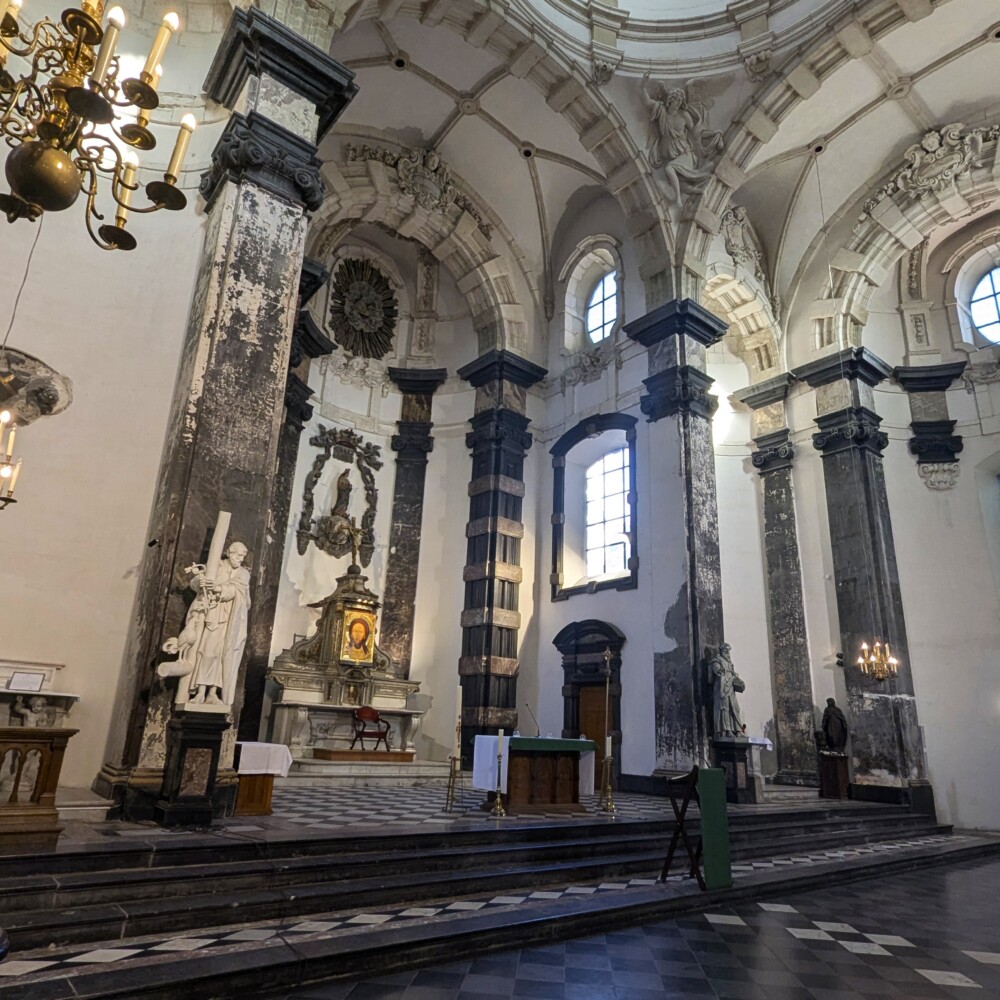
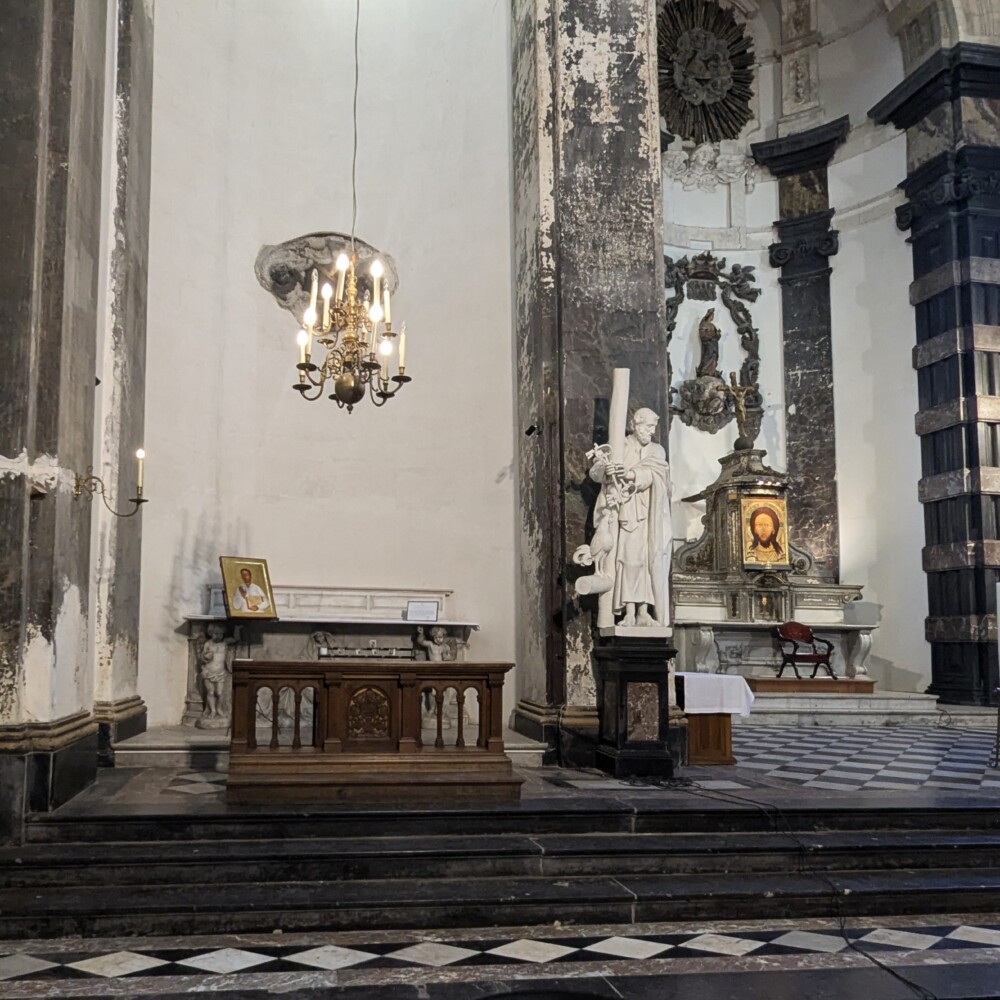
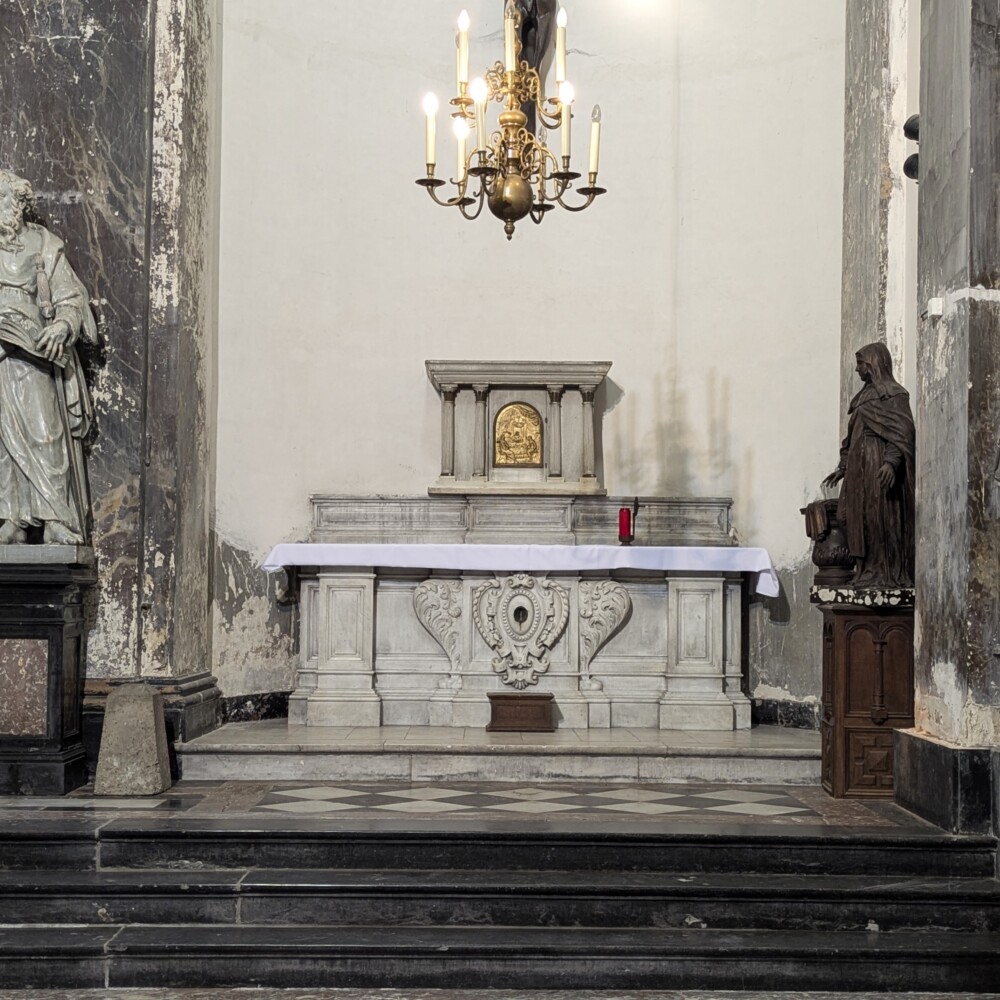
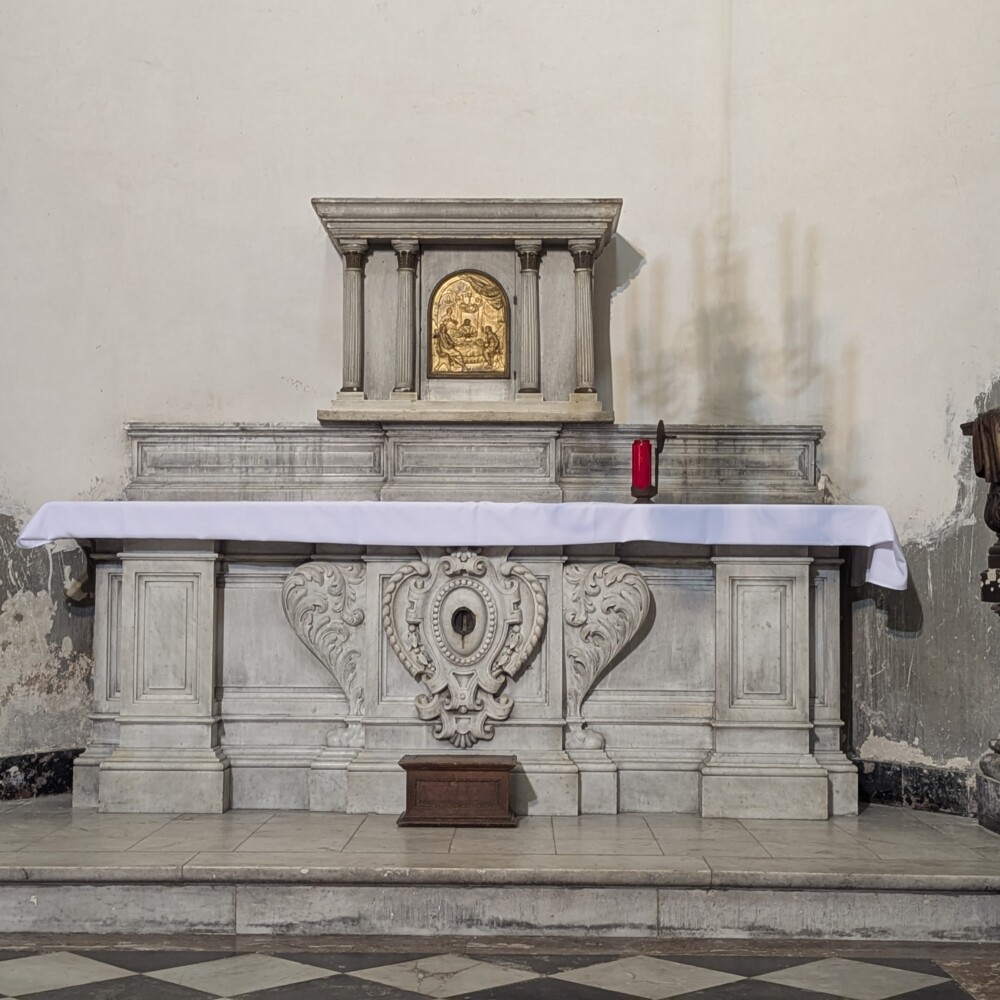
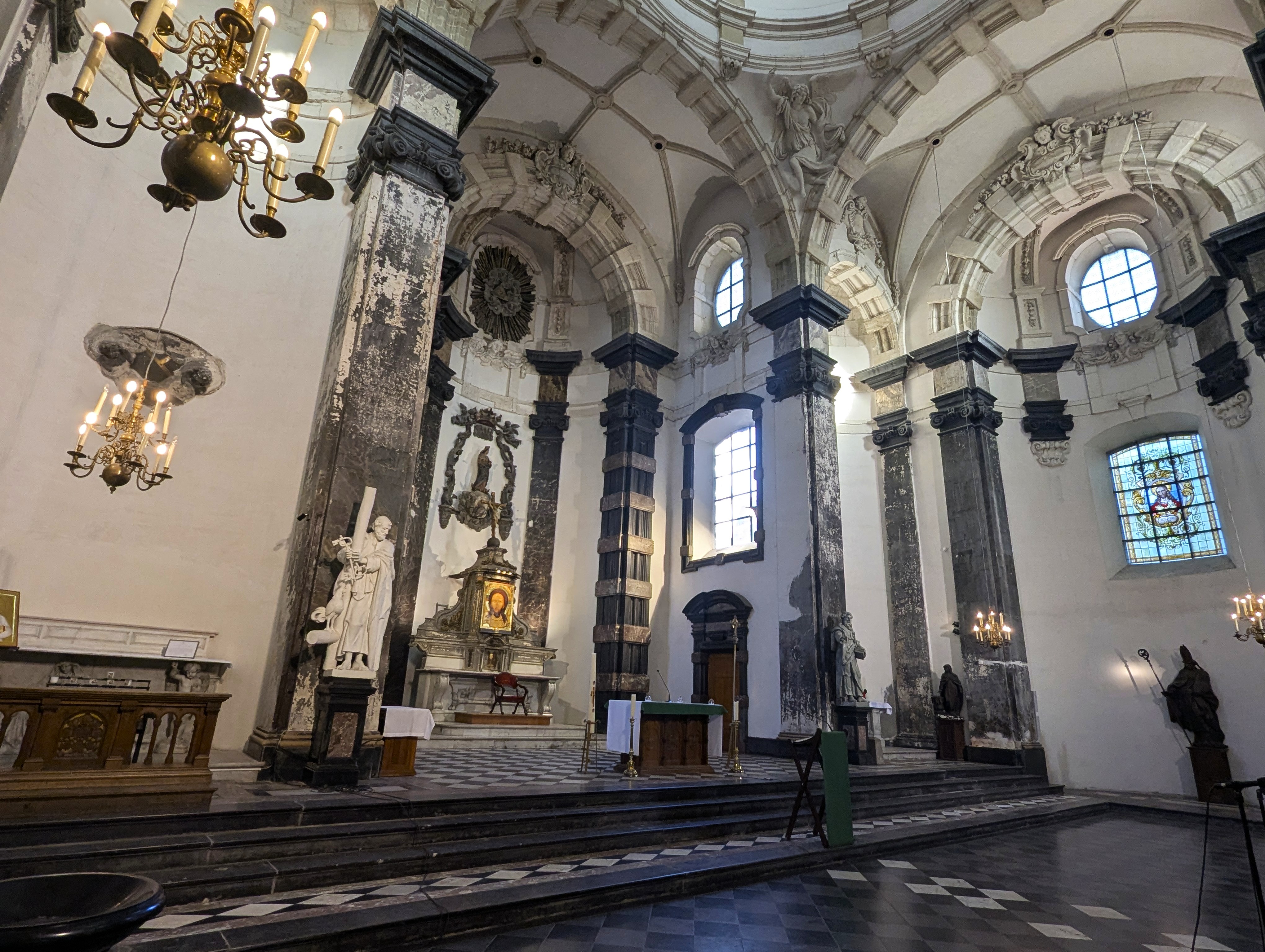
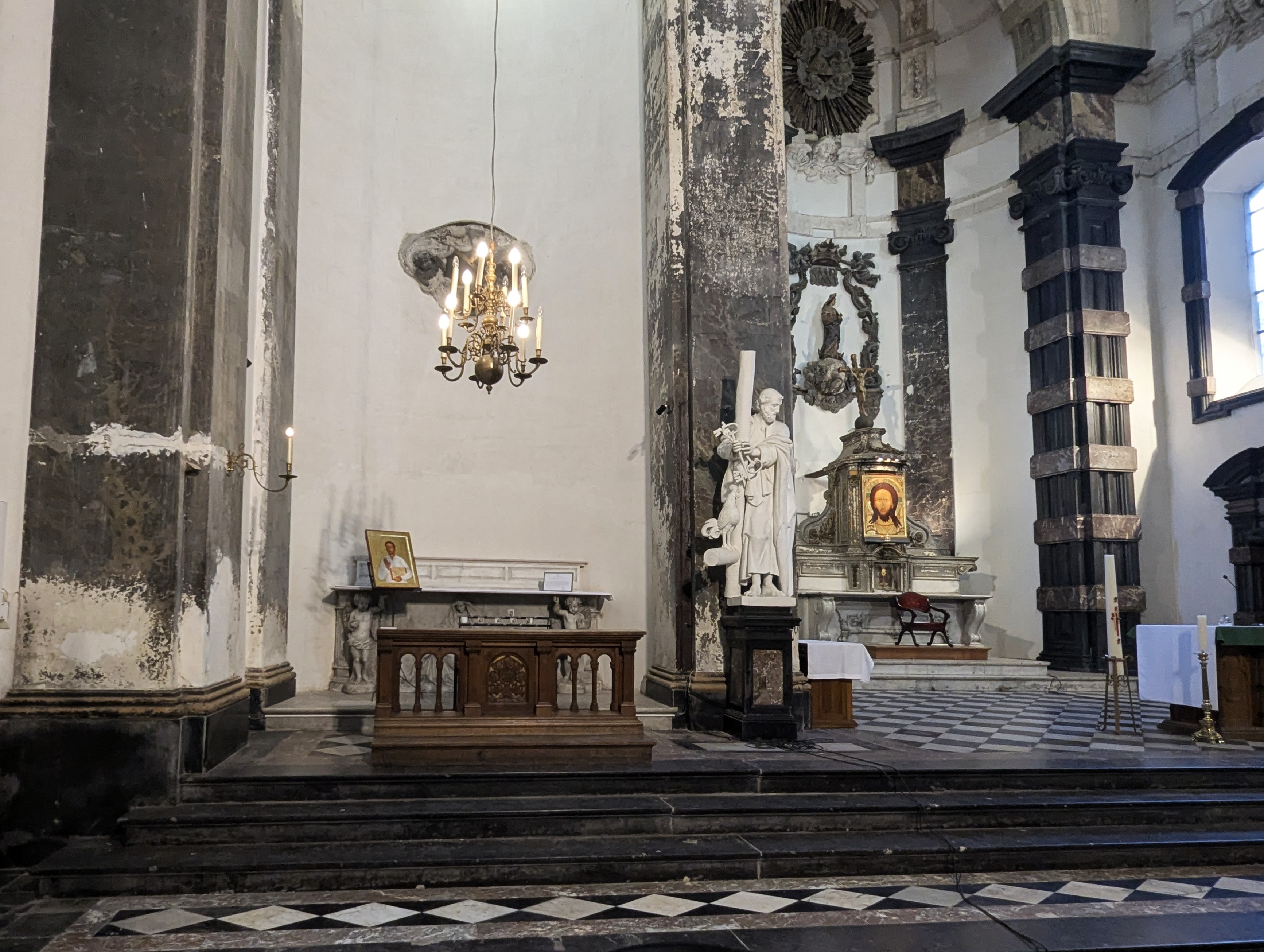
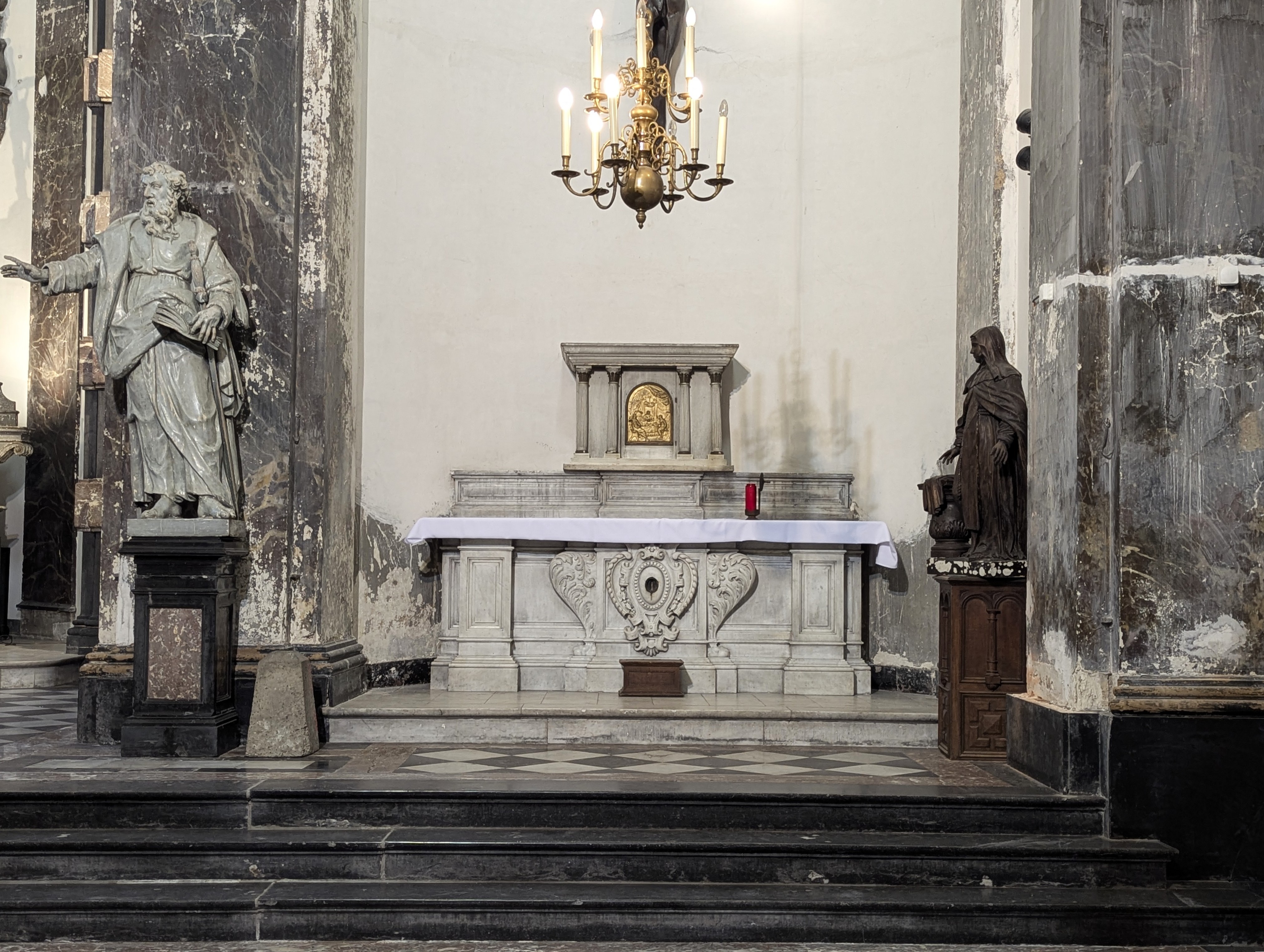
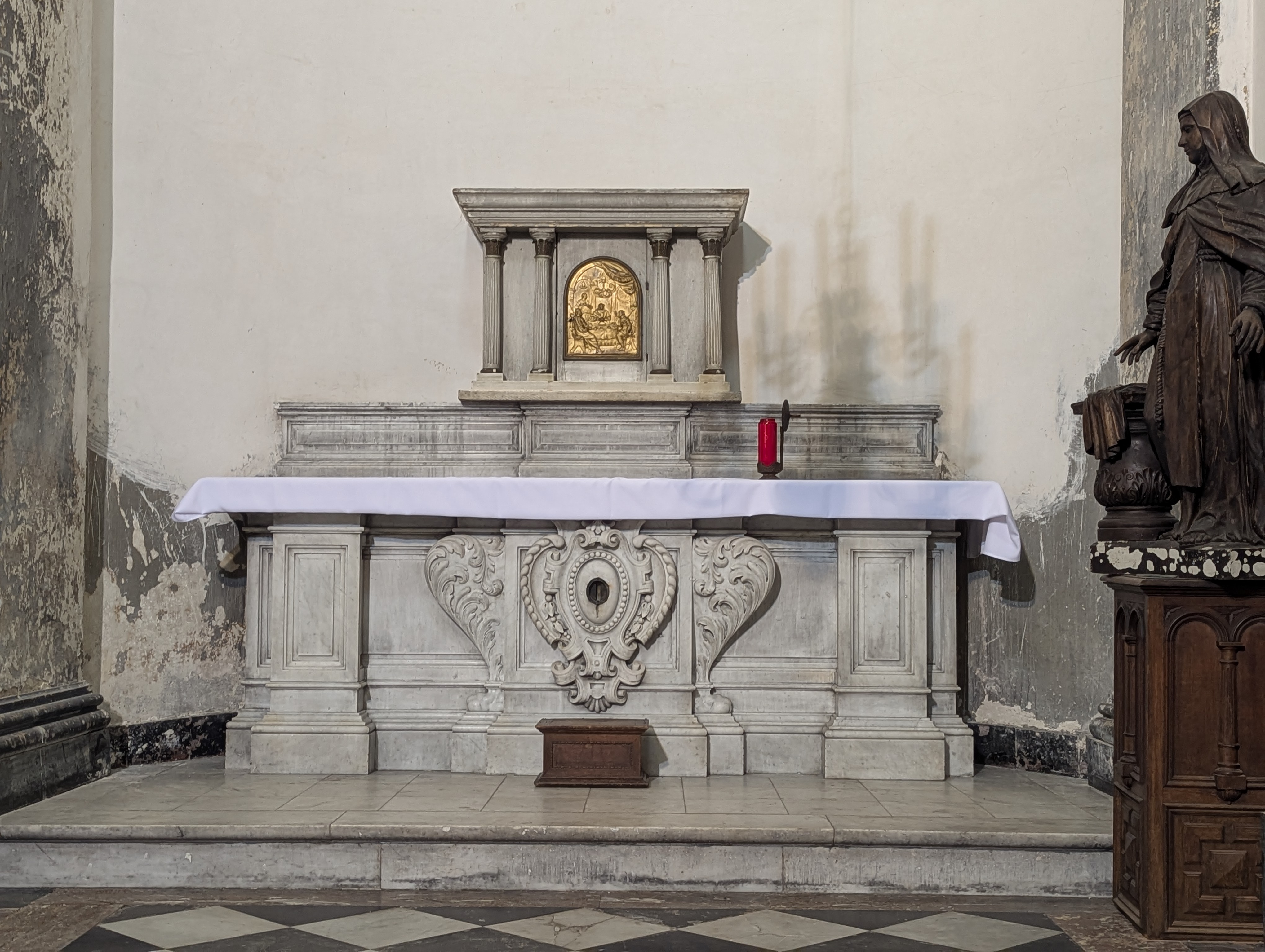
The 18th-century altars of the Sint-Gorikskerk were moved to the Onze-Lieve-Vrouw-ter-Rijke-Klarenkerk (Église Notre-Dame aux Riches Claires). They are now placed in the two side chapels.
Remnants of the River Zenne
With the coverage of the River Zenne, the Groot Eiland (Great Island) that was so remarkable about the unique location of the Sint-Gorikskerk is not longer visible.
There is however a short section of the river that was hidden behind one of the 17th century buildings opposite the Sint-Gorikshallen. With permission, this rare reminder of the original historic Brussels filled with rivers and bridges can be visited. These buildings used to belong to the Rijke Klaren (Rich Clares) who inherited them from the Huis van Nazareth van de Broeders van het Gemene Leven (Brethen of the Common Life) who brought to this spot the first printing press of Brussels.
Sources:
Vannieuwenhuyze, B. (2011) “Brussel, de Ontwikkeling van een middeleeuwse stedelijke ruimte.” Amsterdam: Amsterdam University Press.
Henne, A. Wauters, A. (1845) “Histoire de la ville de Bruxelles. Volume I-III” Brussels: Librairie Encyclopédique de Périchon.
Rombaut, J-A. (1777) “Bruxelles illustrée, ou description chronologique et historique de cette ville.” Brussels: Chez Pauwels.
https://nl.wikipedia.org/wiki/Sint-Gorikskerk_(Brussel)
https://www.volksverhalen.be/Brussel_Sint-Goriks
https://nl.wikipedia.org/wiki/Sint-Goriksplein
https://hallessaintgery.be/
https://collections.heritage.brussels/nl/objects/53070
https://www.bruzz.be/samenleving/jouw-vraag-wat-de-geschiedenis-van-de-sint-gorikshallen-2021-02-11
https://en.wikipedia.org/wiki/Gaugericus
https://nl.wikipedia.org/wiki/Gorik_van_Kamerijk
https://en.wikipedia.org/wiki/Gudulahttps://nl.wikipedia.org/wiki/Sint-Lucasambacht_(Brussel)
https://nl.wikipedia.org/wiki/Bernard_van_Orley
https://archives.bruxelles.be/bernard-van-orley-bruxelles-et-la-renaissance
https://nl.wikipedia.org/wiki/Broederschap_van_Onze-Lieve-Vrouw_van_de_Zeven_Wee%C3%ABn_(Brussel)
-
- Van Deventer, J. (1550-1565) “Atlas of the city of the Low Countries : 73 minutes between 1550-1565 on orders of Emperors Charles V and Philip II” KBR (image)
- Braun, G, Hogenberg, F. (1572-1617) “Civitates orbis terrarum” Universiteitsbibliotheek Utrecht (image)
- de Tailly, M., van der Horst, N., Santvoort, A. D. (1640) “Bruxella nobilissima Brabantiae civitas anno 1640” KBR (image)
- Laboureur, J., Van der Baren, J., Harrewijn, J. (1695) “Bruxella Nobilissima Brabanti Civitasae” Bibliothèque Nationale de la France (image)
- Unknown. (1425-1435) “Van Reynegom-getijdenboek” Koninklijke Bibliotheek van België (image)
- Master of the View of Saint Gudula. (c.1480) “The Preaching of Saint Gaugericus” Louvre (image)
- Unknown (1499-1516) “Accounts book for the years 1499-1516, Broederschap van Onze-Lieve-Vrouw van de Zeven Weeën” Broodhuis (image)
- Unknown. (1565?) “Painting of Count Lambert I kneeling before the original kapel of Sint-Gorikskerk” M Museum Leuven (image)
- Cobergher, W. (1605) “De Graflegging, by Wenceslas Cobergher, Chapel of Our Lady of the Seven Sorrows” KMSK Brussel (image)
- Unknown. (1600s?) “Drawing of the tomb of Bernard van Orley” Broodhuis (image)
- Martin, A. (1720-1760) “Het Koopliedendok. Today’s Baksteenkaai. Sint-Gorikskerk could be seen on the right” Broodhuis (image)
- Unknown (c. 1800) “De Sint-Gorikskerk – Schenking van het gezin De le Court-Chalon” Broodhuis (image)
- Unknown. (c.1799) “Coloured interior view of the Gaugericus church of Brussels” Broodhuis Brussel (image)
- Van Assche, H. (c.1800) “Binnenaanzicht van Sint-Gorikskerk – Schenking van het gezin De le Court-Chalon” Broodhuis (image)
- Van Assche, H. (c.1800) “Afbraak van Sint-Gorikskerk” Broodhuis (image)
- Puttaert, E. (1798-1801) “Tour et entrée principale de Saint-Géry en venant des Riches-Claires” (image)
- Vitzthumb, P. (1798-1801) “Vue de la tour de l’église Saint-Géry pendant sa destruction” Maison du Roi (image)
- Vitzthumb, P. (1798-1801) “Destruction de l’église Saint-Géry” Maison du Roi (image)
- Unknown (c.1880) “Halles Saint-Géry – Chantier” Halles Saint-Géry (image)
- Hoffmann, W. (>1880) “Le Marché St. Géry” Halles Saint-Géry (image)
- Unknown (c.1880) “Halles Saint-Géry” Halles Saint-Géry (image)
- Unknown (c.1880) “Halles Saint-Géry” Halles Saint-Géry (image)
- Hoffmann, W. (>1880) “Le Marché St. Georg” Halles Saint-Géry (image)
- Unknown. (1979) “Sint-Goriksplein, Sint-Goriksmarkt, zicht vanuit Pletinckxstraat, 1979” Archief KCML (image)
- Unknown. (1979) “Sint-Goriksplein, Sint-Goriksmarkt, zicht vanuit Groot Eiland, 1979” Archief KCML (image)
- Unknown. (1979) “Sint-Goriksplein, Sint-Goriksmarkt, zicht vanuit Jules Van Praetstraat, 1979” Archief KCML (image)
HOW IT LOOKS LIKE TODAY
Click on the zoom icon to view the full size.